
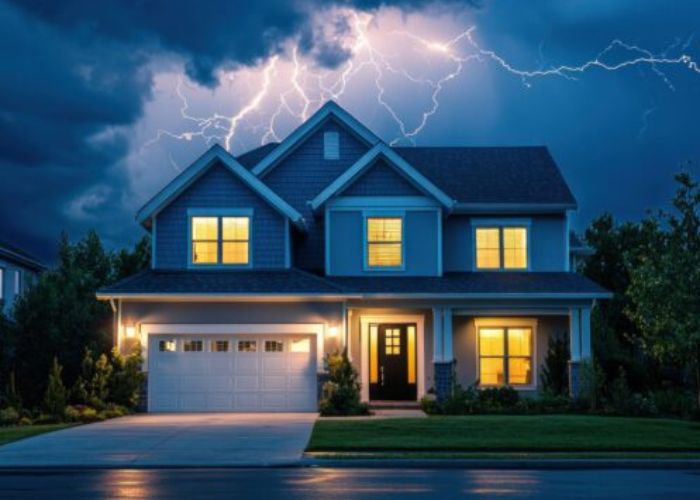
Most Gold Coast homeowners think about storm prep the same way they think about their garage door — they don’t, until something goes wrong. You’ll double-check the windows, move the outdoor furniture, charge the torches, and bring the dog inside. Meanwhile, the largest moving part of your home sits exposed to whatever the sky throws at it, and nobody gives it a second thought. Then a strong southerly rolls up the coast, the door bows under the pressure, a panel buckles, and suddenly water is streaming across the garage floor toward the hot water system and the storage boxes stacked against the back wall.
The garage door is routinely the weakest point in a home’s building envelope during severe weather. When wind loads exceed what an ageing door was designed to handle, the consequences extend well beyond the door itself — a failed garage door can allow pressure to build inside the structure, lifting the roof line and causing catastrophic damage to walls and ceilings. Add in the flooding risk that comes with the Gold Coast’s intense summer downpours and the debris that travels at speed in cyclonic conditions, and you have a genuine structural vulnerability hiding in plain sight.
The good news is that storm-proofing a garage door is neither complicated nor prohibitively expensive. With the right preparation, the right upgrades, and a regular maintenance rhythm, most homeowners can significantly reduce their exposure before the next weather event arrives. This guide walks through everything you need to know — from understanding where your door is vulnerable, to practical DIY steps, to the upgrades worth investing in for long-term peace of mind.
Why Garage Doors Are Vulnerable in Storms
Your garage door is the largest opening in your home’s exterior, often spanning 2.1 to 2.4 metres high and up to 5 metres wide. It’s also a moving part, which means it’s held in place by springs, cables, tracks, and mounting hardware rather than being built directly into the wall structure. That combination — large surface area, mechanical installation — makes it particularly susceptible to the forces generated during severe weather events.
Understanding Storm Hazards
High winds are the most immediate threat. Even a standard summer storm on the Gold Coast can generate sustained wind speeds capable of bowing an older door inward or outward, placing enormous stress on the track brackets and mounting hardware. In cyclone-adjacent conditions — and the Gold Coast sits within reach of tropical systems that track down the Queensland coast — wind loads can be severe enough to detach panels entirely or tear the door from its mountings.
Rain and flooding create a different but equally serious problem. Most standard garage doors leave gaps at the bottom, sides, and top that allow driven rain to enter freely. Once water is inside, it damages flooring, corrodes metal components, soaks stored belongings, and creates conditions that lead to mould growth in wall cavities. Homes in low-lying Gold Coast suburbs face the added risk of surface flooding pushing water under the door from outside.
Flying debris is underappreciated as a garage door hazard. Unsecured outdoor items, branches, and airborne material travel at significant speed in strong winds. A direct impact to a standard steel or aluminium panel can crack or dent it badly enough to compromise the door’s structural integrity, making it harder to close fully after the storm has passed.
Pre-Storm Preparation Steps
1. Inspect and Maintain Your Door
Before storm season — roughly October through April on the Gold Coast — conduct a thorough inspection of every moving part. Check the tracks for alignment and clear them of debris. Look at the hinges for signs of rust or stress fractures. Examine the mounting brackets and tighten any bolts that have worked loose through normal operation. Close the door fully and look for gaps around all four edges; any daylight visible around the perimeter is a weather vulnerability.
This is also the right time to test the manual override on your opener. During a power outage, you need to be able to operate the door by hand — and if the springs are fatigued or the cable is fraying, that may not be possible safely. If you’re seeing any of the warning signs covered in our garage door troubleshooting guide, address them before the wet season begins rather than after.
2. Add Bracing and Reinforcements
Older sectional doors — particularly those more than 10–15 years old — often lack the internal bracing required to handle modern wind load standards. Vertical strut kits are available as a retrofit option; these bolt across the width of each panel and dramatically increase the door’s resistance to bowing under pressure.
Steel horizontal reinforcement kits add a second layer of protection by stiffening the door along its full width. For DIY-capable homeowners, these kits are available through hardware suppliers and include everything needed for installation. For larger doors or those in higher-risk locations, professional installation ensures the bracing is correctly tensioned and anchored into the structural framing rather than just the door skin.
3. Upgrade Weather Seals
A comprehensive seal upgrade is one of the most cost-effective storm-proofing investments available. The bottom seal — the rubber or brush strip that runs along the base of the door — takes the most punishment and should be replaced if it’s cracked, compressed flat, or no longer making full contact with the floor. Side seals and top seals close off the gaps around the door frame that allow wind and driven rain to penetrate.
For homes in flood-prone areas, a threshold seal installed on the garage floor in front of the door creates a raised barrier that helps keep surface water out. Pair this with correctly installed side seals and you have a significantly more waterproof system.
This connects to a broader point about energy efficiency too — the same gaps that let storm water in are letting conditioned air out year-round. Our post on fixing garage door gaps for energy efficiency covers the sealing process in detail and is worth reading alongside this one.
4. Consider Cyclone or Wind-Rated Doors
If your current door is more than 15 years old, or if it’s shown any signs of structural weakness during past weather events, the most reliable long-term solution is upgrading to a wind-rated door. Australian Standard AS 4055 classifies wind regions across the country; the Gold Coast sits in a wind region that demands doors capable of handling significant lateral loads.
Modern wind-rated sectional doors are engineered with reinforced panels, heavier-gauge steel, stronger track systems, and multi-point locking mechanisms. They’re tested to specific wind speed ratings and certified under Australian building codes. Sectional doors are generally easier to engineer to a high wind rating than roller doors, because the panel-and-track system allows for internal reinforcement. Roller doors can also be wind-rated, but the options are more limited and they’re typically less effective at keeping driven rain out.
Brands like B&D and Merlin manufacture doors rated for cyclone-adjacent conditions, and any reputable installer will be able to advise on the correct specification for your wind region and building type.
5. Secure Your Garage Door Opener and Accessories
Standard garage door openers engage a locking mechanism when the door is closed, but in very high winds this may not be sufficient on its own. Dedicated wind locks — side-mounted bolt mechanisms that engage into the track independently of the opener — provide additional holding strength and are a worthwhile addition in higher-risk locations.
Fit a battery backup unit to your opener so the door remains operable during power outages. Add a surge protector to guard the opener’s electronics against voltage spikes that commonly occur when power is restored after an outage. If your current opener is an older model, this is also a good time to evaluate whether an upgrade makes sense — modern openers, including smart models reviewed in our guide to smart garage door openers in Australia, include features specifically designed to improve security and reliability in adverse conditions.
DIY Maintenance Checklist for Storm Season
Run through this checklist at the start of each storm season and again mid-season:
- Inspect all hinges and tighten loose bolts
- Check tracks for alignment, dents, or obstructions
- Test bottom, side, and top seals for compression and continuity
- Lubricate springs, rollers, and hinges with garage door lubricant (not WD-40)
- Test the door’s manual operation — disconnect the opener and operate by hand
- Test the opener’s auto-reverse function with a piece of timber on the floor
- Check mounting brackets and bolts at the wall and ceiling
- Clear the area in front of the door of items that could become projectiles
- Confirm the opener’s battery backup is charged and functional
If you’re considering an insulated door upgrade as part of your pre-season work, storm season is an ideal time — insulated panels are inherently more rigid and offer better resistance to wind load than single-skin alternatives.
Sectional vs Roller Garage Doors for Storm Safety
| Feature | Sectional Door | Roller Door |
|---|---|---|
| Wind reinforcement options | Extensive — vertical struts, horizontal kits | Limited — fewer retrofit options |
| Weather sealing | Perimeter seals on all four edges | Bottom seal only; sides less controlled |
| Structural strength | Panel system allows internal bracing | Curtain design limits reinforcement |
| Wind-rated certifications | Widely available | Available but fewer models |
| Insulation | Easily integrated into panels | Possible but less effective |
| Space requirement | Requires ceiling clearance for operation | Space-saving, good for low ceilings |
For homes in storm-prone coastal areas, a sectional door is generally the more practical choice when storm resilience is a priority. That said, a well-maintained roller door with upgraded seals and a wind lock is significantly better than a neglected sectional door with failing hardware — and many common roller door problems that compromise storm performance can be repaired cost-effectively.
Professional Support and Upgrades
There’s a point in every storm-proofing project where DIY stops being the right answer. Installing vertical bracing kits requires accurate measurement and secure fastening into structural framing — done incorrectly, they can do more harm than good. Fitting a wind-rated door requires professional installation to maintain the certification. And if your springs or cables are showing signs of fatigue, these are components that can cause serious injury if they fail during handling.
The A1 Garage Doors Gold Coast team provides pre-season inspections across the Gold Coast, assessing your door’s current condition and recommending targeted upgrades based on your door type, age, and location. A professional inspection before the wet season is far less expensive than emergency call-outs after storm damage — and it gives you accurate information about where your door actually stands rather than hoping the existing setup will hold.
Contact A1 Garage Doors Gold Coast on (07) 5515 0277 to arrange a pre-storm inspection or get advice on upgrading to a wind-rated door before the season peaks.
Frequently Asked Questions
How do I know if my garage door is storm-proof?
A storm-proof door will carry a wind-speed rating tested and certified under Australian Standards. Check your door documentation or the manufacturer’s label on the door. If there’s no rating listed, assume the door has not been engineered specifically for storm conditions. An inspection by a qualified technician can assess its current structural condition.
Can I reinforce my existing door without full replacement?
Yes, in many cases. Vertical strut kits and horizontal reinforcement bars can be retro-fitted to existing sectional doors, significantly increasing their wind resistance. Seal upgrades and wind locks can also be added without replacing the door. Whether reinforcement is cost-effective depends on the door’s age and current condition — a technician can advise based on a physical inspection.
Which type of door is best for high-wind areas?
Wind-rated sectional doors are generally the preferred option for high-wind coastal areas. They offer the most reinforcement options, the best sealing characteristics, and the widest range of certified products. That said, wind-rated roller doors are available for applications where ceiling space is limited.
How often should I inspect and maintain storm protections?
Conduct a thorough inspection at the start of each storm season (around October) and a lighter mid-season check in January or February. Additionally, inspect after any severe weather event — even if the door appears undamaged, hardware can shift or loosen during high wind loads in ways that aren’t immediately visible.
What should I do with my garage door if a storm is imminent?
Close and lock the door. Do not leave it partially open — an open door allows internal pressure to build dramatically, which is more structurally dangerous than a closed one. Engage any wind locks. Disconnect the opener if power failure is likely. Move any vehicles, tools, or stored items away from the door in case a panel fails inward.
Ready to prepare your garage door before the next storm hits? Call A1 Garage Doors Gold Coast on (07) 5515 0277 or visit goldcoastgaragedoorrepair.com.au to book a pre-storm inspection or discuss upgrading to a wind-rated door. Our team serves the Gold Coast and surrounds — don’t wait until the storm is already forecast.
