
How much wind can a garage door withstand? There is no single wind speed that applies to every door. Wind resistance depends on the door’s tested rating, its size, the quality of the installation, the strength of the wall around it, and the condition it’s in. An unrated door has no guaranteed figure at all.
That may not be the simple number you wanted. But knowing why there’s no universal answer helps you judge your own door. At A1 Garage Doors Gold Coast, we help local homeowners understand garage door damage and repair options. These are important questions to consider before storm season. Here are clear answers.
How Much Wind Can a Typical Garage Door Withstand?
A standard door with no wind rating has no tested limit you can rely on. It may survive years of ordinary storms, then fail in one severe event. Age, wear and loose fixings lower the real figure further.
A wind-rated garage door is different. Its product specification identifies performance under a relevant standard such as AS/NZS 4505, with a rating that can be assessed against the site’s design requirements. Even then, the rating covers that door, correctly installed, on a structure that can carry the load. It is not a promise that any door will survive any storm.
Wind Speed vs Wind Pressure: What’s the Difference?
These terms get mixed up, so keep them apart.
- Wind speed is how fast the air moves — the garage door wind speed figure you hear in forecasts, in kilometres per hour.
- Wind pressure (or wind load) is the force that air pushes against a surface. Engineers measure it in pascals (Pa) or kilopascals (kPa).
Pressure is what acts on your door, and it grows much faster than speed. Double the speed and the pressure roughly quadruples. That is why a small jump in forecast wind speeds can mean a much bigger garage door wind load. Rated doors quote this garage door wind pressure in pascals on their test paperwork.
Australian housing design uses gust speeds in metres per second. To convert, 1 m/s equals 3.6 km/h, so 50 m/s is about 180 km/h.
What Is a Garage Door Wind Rating?
A garage door wind rating means the door has passed a standardised wind-pressure test. In Australia the test sits in AS/NZS 4505. The rated door is matched to a wind class: N1 to N6 for non-cyclonic areas, or C1 to C4 for cyclonic ones. A higher number means a stronger design wind.
For context, the design gust speeds behind the classes run from 34 m/s (N1, about 122 km/h) to 86 m/s (C4, about 310 km/h). An N class and a C class at the same speed are not interchangeable. Cyclonic testing adds hours of repeated buffeting, so a C-class door has passed a tougher test.
Two limits apply to every wind resistance rating. It covers the tested assembly — curtain or panels, tracks or guides, wind locks, brackets and fixings — installed as the maker specifies. And it assumes the surrounding structure can take the load. A wind class also describes the design wind for a site. It is not a guaranteed survival speed for your door.
There’s a surprise in how the pass mark works, too. A door can pass its wind load rating test and still come out bent or unusable. Passing means the door stayed in the opening — nothing broke loose or let it open. “Withstands the wind” means holds the building closed, not “looks new afterwards”.

What Affects Garage Door Wind Resistance?
Door size, type and panel strength
Wider doors catch more wind, so ratings are always tied to door width. A door rated at 2.4 metres wide does not keep that rating at 5.5 metres. Panel and curtain strength matter as well. Heavier materials and reinforcing struts (steel stiffeners fixed across the panels) raise resistance.
Tracks, fixings, frame and structural support
The guides and tracks hold the door in the opening. Wind-rated roller doors add wind locks — clips on the curtain edges that lock into shaped side guides so the curtain cannot blow out. All of this hardware is only as strong as what it is fixed to, because wind forces pass from the door into the wall around the opening. Weak or rotting framing undermines the lot.
Condition, location and building exposure
A door on an exposed ridge or open acreage faces higher wind loads than the same door on a sheltered street. That is why wind classification is worked out property by property, using the site’s region, terrain, shielding and topography. Age finishes the picture. A twenty-year-old door with loose guides will not match its original performance, rated or not.

Do Roller Doors and Sectional Doors Differ in High Winds?
Neither type has an inbuilt advantage, and no door can withstand strong winds unless the specific product is rated and correctly installed.
Roller doors historically fail when the curtain pulls out of its guides — the problem wind locks solve. Sectional doors tend to fail by garage door panels buckling, which is why rated sectional doors use struts and heavier hardware. Makers publish their own tested results. Steel-Line, for example, states its wind-rated roller doors have passed wind pressure rating requirements for classes N1 to N4 and C1 to C4, with the higher cyclone classes limited to narrower widths, tested at the James Cook University Cyclone Testing Station. That tells you about that product range — not about roller doors in general.
How Are Wind-Rated Garage Doors Tested in Australia?
Testing to AS/NZS 4505 happens in facilities like the Cyclone Testing Station at James Cook University, where air pressure is applied to the mounted door to simulate wind load. Non-cyclonic doors get a static test: pressure applied and held. Cyclonic doors face a fatigue sequence — over a thousand push-pull cycles at rising pressures, mimicking hours of buffeting. An optional flying-debris impact test can be added where a project calls for it.
To pass, the door must stay in place. No parts dislodged, no connections broken in a way that would let it open.
How Can You Check Your Garage Door’s Wind Rating?
- Look for a label. Some rated doors have a sticker or plate identifying the model, standard or rating. Check the inside face, the bottom edge and the tracks.
- Check a roller door’s edges. Clips along the curtain that run inside shaped guides are wind locks — a strong sign of a rated product.
- Check your paperwork. The door manual, builder’s handover documents or building contract may name the model and your home’s wind class. Newer homes have a wind class on the plans. Keep these documents — they also help with insurance questions after a storm.
- Ask the manufacturer or installer. With the brand and model, the maker can often confirm the rating.
No label does not prove the door is unrated — marking was optional under the older 1998 version of the standard. But you cannot count on a rating you cannot verify. Plan as if the door is unrated until you know otherwise.
Can an Older Garage Door Be Reinforced for High Winds?
Sometimes — but only with engineered, product-specific solutions. The Queensland Reconstruction Authority’s cyclone resilience guidance offers two paths: replace the door with one that complies with AS/NZS 4505 and carries the right rating for your location, or fit certified temporary braces designed for the existing door. Some rated sectional doors accept removable steel wind brace posts that go on when a cyclone warning is issued.
Two cautions apply. Bracing only works if it is designed and approved for your specific door — homemade bars or timber props add no tested capacity. And a wind-rated door pushes more load into the garage walls, so the structure sometimes needs strengthening too. Plan that work well before storm season.
One firm line on DIY: never tension springs, adjust cables or modify tracks to “stiffen” a door. These parts are under load. Altering them can make the door unsafe and weaker in wind.
What Happens When Wind Overloads a Garage Door?
The door itself is only the start. When a garage door blows in or pulls out of its guides, wind rushes in and the home’s internal pressure jumps. That pressure pushes up on the roof and out on the walls. Roof and ceiling damage can follow, and the costs often run well beyond the value of the door.
This is not theory. After Cyclone Yasi in 2011, the Cyclone Testing Station found almost a third of garage doors in newer homes had failed. Half of those doors broke loose completely and became wind-borne debris. The garage door is the largest opening in most homes. When it lets go, the rest of the building feels it.
What Should Gold Coast Homeowners Know Before Storm Season?
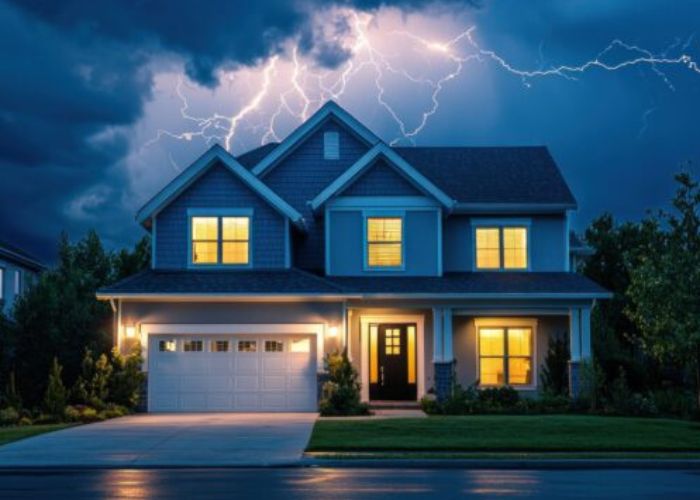
The Gold Coast can experience severe thunderstorms and damaging winds. The applicable wind region and design requirements should be confirmed for the specific property rather than assumed from a suburb name. Your home has its own site-specific wind class within that region, worked out under AS 4055 (the wind loads for housing standard), or AS/NZS 1170.2 for larger or unusual buildings. An engineer or certifier determines it; it is not one figure for every Gold Coast or Helensvale property.
The National Construction Code (NCC) includes requirements for garage doors in relevant wind regions and applications, with AS/NZS 4505 used for applicable doors. For any particular home, check the approved plans, door specifications and current building requirements rather than assuming an existing door is compliant.
Before summer, check the door’s label and paperwork, look for worn guides and loose fixings, and deal with a rattling or flexing door early. For practical preparations, see our garage door safety during storms guide. For long-term wear caused by changing weather, read how weather affects garage doors. This article stays focused on wind capacity.
When Should a Wind-Damaged Garage Door Be Inspected?
After a severe storm, look for bowed or creased panels, a curtain sitting unevenly, gaps between curtain and guides, or new scraping and jerking as the door moves. If you see any of these, stop using the door. Running a buckled or dislodged door can tear it further and can be dangerous.
An inspection tells you whether repair or replacement makes more sense, and whether the opening and structure are still sound. If you’re local, our team handles garage door repairs in Helensvale and across the Gold Coast, and we can tell you honestly which way a damaged door is leaning.
Frequently Asked Questions
Can a garage door withstand 100 km/h winds?
There is no honest yes-or-no without knowing the door. For context, the lowest Australian design wind class (N1) uses a gust speed of about 122 km/h — but that class describes the site, not your door. A rated door matched to your home’s class is designed for its share of severe weather. An unrated or worn door has no assured figure at any speed. How much wind can a garage door take? It always comes back to the door, the installation and the structure.
Are wind-rated garage doors cyclone-proof?
No door is cyclone-proof. A cyclone-class rating (C1 to C4) means the door passed a cyclonic fatigue test at a set pressure, installed as specified. Extreme weather can exceed any design figure. The whole structure and installation matter, not just the product badge.
Does adding bracing guarantee higher wind resistance?
No. Bracing helps only when it is an engineered product approved for your specific door and correctly fitted. Random props or DIY bars add no tested capacity, and a brace does not fix a weak wall or worn tracks.
Does the garage door opener affect wind strength?
No. The opener (the motor) only opens and closes the door. Wind resistance comes from the curtain or panels, the guides, the wind locks and the fixings. In a storm warning, a motorised door should stay closed — and never be relied on if the power fails.
Need Advice About Your Garage Door’s Wind Resistance?
Not sure what your door is rated to, or spotted bowing, rattling or worn tracks after a storm? It is worth a look before the next one arrives. A1 Garage Doors Gold Coast can help assess your door’s condition, discuss rated replacement options where appropriate, and arrange further checks of the installation or surrounding structure where needed. Get in touch for a straightforward local opinion — a clear answer on where your door stands.
