
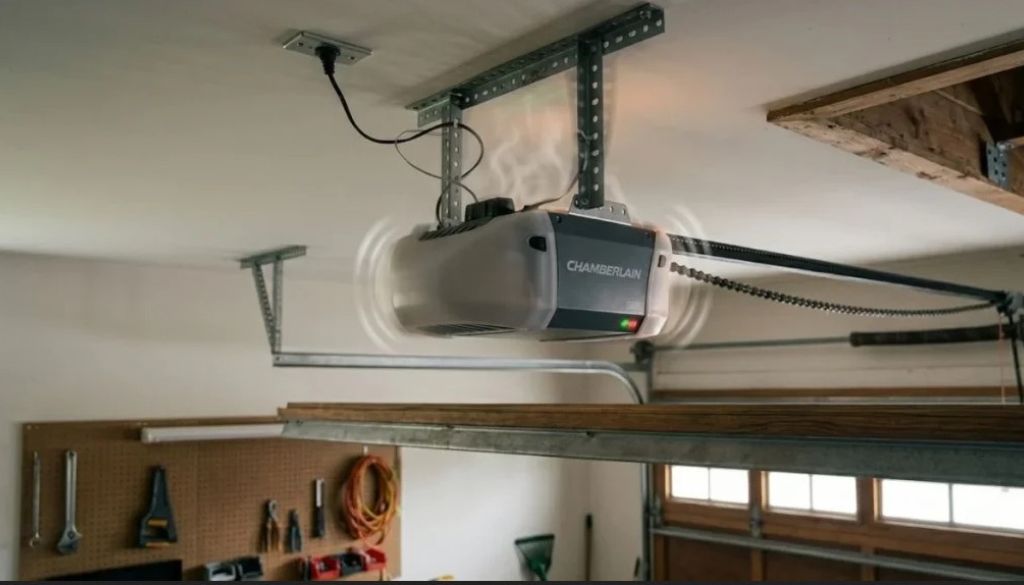
You press the remote, the motor hums, and nothing happens. The door sits exactly where it was. It is a confusing fault, because the opener clearly has power and is clearly trying to work.
That hum is useful information. It tells you the electrical side is alive and the motor is drawing current. What it cannot tell you is whether the problem sits inside the opener or in the door itself — two very different repairs.
Below are the likely causes, the checks that are safe to do yourself, and the components to leave alone entirely.
Why Is My Garage Door Opener Humming but Not Moving?
A humming opener is a motor under load that cannot complete its job. Something is stopping that energy turning into door movement.
Most homeowners assume the opener has failed. In practice, it is often the victim. A garage door is a counterbalanced system, and the motor is only designed to guide a door that is already close to weightless. When springs, tracks or rollers stop doing their share, the motor is asked to lift a heavy slab of steel it was never rated for. It hums, strains, and gives up. If your garage door opener motor is running but the door won’t open, professional garage door opener repair can help identify and resolve the underlying issue.
Before writing off the motor, rule out the door.
The Garage Door Is Stuck or Obstructed
Pull the emergency release cord to disengage the opener, then lift the door by hand. A healthy door moves smoothly and stays put when you let go around waist height.
Look along both tracks for objects or debris. Coastal Gold Coast garages collect salt and sand, which cakes into the tracks and creates real resistance. If the door fights you at a specific point, note where — that usually identifies the faulty component. If it will not budge at all, do not force it.
The Garage Door Is Too Heavy for the Opener
If the door feels genuinely heavy once disengaged, the counterbalance system is the problem. A balanced door feels like a fraction of its actual mass; an unbalanced one can weigh 60 kilograms or more in your hands.
That weight goes through the drive mechanism every cycle, causing overheating, inconsistent operation and eventually a hum with no movement. Spring tension adjustment is not a homeowner job.
The Opener Motor Is Struggling
If the door moves freely by hand but the opener still hums, the unit itself is the suspect. A motor that hums without turning is usually failing to start under load. Repeatedly cycling it tends to finish it off.
Common Causes of a Humming Garage Door Opener
Worn or Damaged Drive Gears
Most residential openers use a plastic main gear meshed with a worm drive — a deliberate weak point, cheaper to replace than a motor. When those teeth strip, the motor spins freely inside the housing while the chain, belt or shaft stays still. The telltale signs are a hum that sounds normal, no door movement, and often plastic shavings on the floor.
Broken or Worn Garage Door Springs
Springs carry almost the entire weight of the door. When one snaps or loses tension, the door becomes dead weight and the opener has no chance. You will usually hear a loud bang when it happens, and may see a visible gap in the coil. Never attempt to release, adjust or replace a spring yourself.
Track, Roller or Alignment Problems
Bent tracks, seized rollers and misaligned brackets all add friction. Enough friction and the motor stalls, producing exactly the humming symptom. Worn roller bearings are common on doors over a decade old, and sectional doors can bind partway through travel — our guide to a garage door jamming between panels covers that scenario.
Motor or Electrical Problems
The motor relies on a start capacitor to get moving. When that capacitor degrades, the motor receives power but cannot develop enough torque to start — the classic hum-without-rotation fault. Windings, control boards and wiring can also fail with age. None are safe to open at home; capacitors can hold a charge after the unit is unplugged.
Jammed or Corroded Components
Salt air, humidity and long periods of disuse cause corrosion in bearings, hinges and shafts. Surface grime can be cleaned away, but anything corroded to the point of seizing needs parts replaced, not lubricated.
What to Check When Your Garage Door Opener Hums
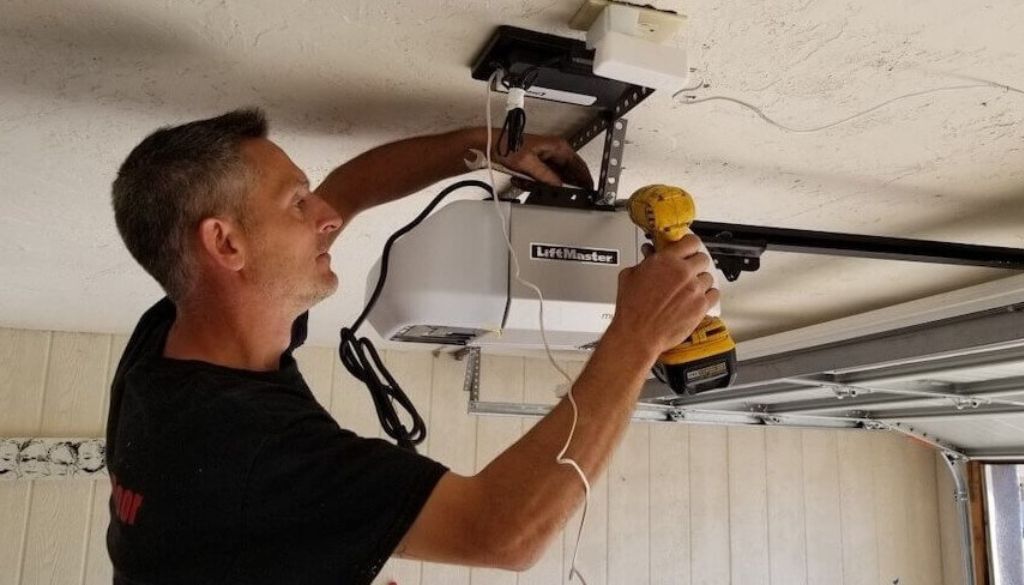
Work through these in order. Stop at any point where something feels wrong.
1. Clear the area. Remove anything near the door and check both tracks for debris.
2. Test the door manually. Pull the emergency release and lift by hand. Note whether it moves freely, binds at a point, or feels heavy.
3. Inspect tracks and rollers. Look for bends, gaps between track and wall, or rollers sitting out of line. Do not try to straighten a bent track.
4. Confirm power. Check the unit is plugged in and the breaker has not tripped. Do not open the opener housing.
6. Rule out the controls. Replace the remote batteries and try the wall button. If the wall button works and the remote does not, the fault is in the remote.
7. Listen carefully. A continuous hum, a hum that cuts out after a few seconds, grinding, clicking or rattling all point to different faults.
For a broader starting point, our complete garage door troubleshooting guide covers the full range of common faults.
Symptom, Cause and Action at a Glance
| Symptom | Likely Cause | What to Do |
|---|---|---|
| Hums continuously, door still | Start capacitor or motor fault | Stop cycling, book diagnosis |
| Hums, door feels heavy by hand | Broken or worn spring | Stop using the door, arrange service |
| Hums or whirrs normally, nothing moves | Stripped drive gear | Professional gear replacement |
| Hums briefly then cuts out | Thermal overload tripping | Allow to cool, book diagnosis if repeated |
| Hums and grinds at one point | Track, roller or alignment fault | Visual inspection, then service |
| No hum, no movement | Power or control board fault | Check breaker, then book diagnosis |
Why Is the Opener Humming but the Motor Not Turning?
Internal motor failure. A degraded start capacitor or damaged winding lets current flow without producing rotation — the most common cause of a pure hum in an older unit.
Drive mechanism failure. The motor turns normally, but a stripped gear, broken chain or failed coupler means nothing reaches the door. Put your ear near the drive head; rotation without door movement points here.
Thermal protection. Frequent cycling or an overweight door causes the thermal cut-out to trip. Leave it 20 to 30 minutes and try once more. If it repeats, the overheating is a symptom of an underlying fault.
Can You Fix a Humming Garage Door Opener Yourself?
Reasonable to do yourself: clearing obstructions, cleaning debris from tracks, replacing remote batteries, checking the breaker, and testing the door manually.
Leave to a technician: anything involving springs, cables, drive gears, capacitors, control boards or wiring.
Stop immediately if the door feels unusually heavy, a spring or cable looks damaged or slack, the door sits crooked in the tracks, or the fix would require opening the opener housing. Spring and cable failures cause serious injuries every year in Australia.
Repair or Replace the Garage Door Opener?
Repair usually makes sense when the unit is under about ten years old, the fault is isolated to one replaceable part, and the rest of the system has been reliable.
Replacement is often the better call when the opener is 10 to 15 years old, faults recur, parts are no longer available, or the unit lacks current safety features. Our garage door opener comparison breaks down the drive types, and our overview of motor options available in Australia covers the configurations commonly fitted to Gold Coast homes.
Modern units run quieter on belt drive, include auto-reverse and photo-eye safety systems, offer battery backup for storm outages, and connect to smartphone apps.
How to Stop the Humming Coming Back
Most humming faults are the end point of a slow decline, not a sudden event. Keeping tracks clean, checking rollers and hinges for wear, and acting on unusual noises early prevents most of them. Following a consistent garage door maintenance schedule is the simplest way to stay ahead of it.
Door balance matters most. A properly balanced door means the opener does almost no lifting, which directly extends motor and gear life. An annual inspection catches worn rollers, loosening hardware and early spring fatigue before they strand you.
Get Your Humming Opener Diagnosed on the Gold Coast
If your opener is humming and the door will not move, stop cycling it — every attempt strains a motor or gear that is already failing.
A1 Garage Doors Gold Coast has serviced residential and commercial doors across the Gold Coast and parts of Brisbane since 2020, with a 4.9-star review rating. Our technicians identify whether the fault sits in the motor, the drive mechanism, the springs or the tracks, then repair or replace only what needs it.
Call (07) 5515 0277 to book an inspection, or request a quote through our website. We are based at 1 Waterford Ct, Bundall QLD 4217.
Frequently Asked Questions
Why is my garage door opener humming but not moving?
The motor has power but cannot move the door — either an opener fault such as a failed capacitor or stripped gear, or a door fault such as a broken spring or jammed track.
Why does my garage door motor hum but not turn?
Usually a failed start capacitor. The motor receives current but cannot generate enough torque to begin rotating.
Can a broken spring cause the garage opener to hum?
Yes. Without spring counterbalance the door becomes dead weight and the opener stalls trying to lift it.
Can a garage door opener motor be repaired?
Often yes — capacitors, gear kits, boards and limit switches are all replaceable. Whether it is worthwhile depends on age and parts availability.
Should I replace a humming garage door opener?
Replace it if the unit is over 10 to 15 years old, faults recur, or it lacks auto-reverse and battery backup.
Is it safe to manually open a garage door when the opener is humming?
Only if it moves freely once the emergency release is pulled. If it feels heavy or sits crooked, leave it closed.
